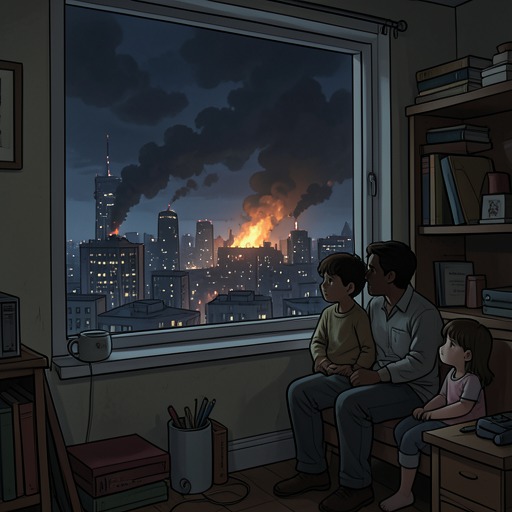
Fabrizio Collini—Nicola Collini: father and son
The Collini CaseThe relationship between Fabrizio Collini and Nicola Collini is presented through the ordinary closeness of a father and his children, then broken by arrest and death. Nicola’s clandestine partisan activity makes the family vulnerable to German repression; his capture leaves Fabrizio and his sister to face the loss without explanation, and the eventual news that Nicola’s name is among those of executed prisoners turns the father’s disappearance into a permanent bereavement. Uncle Mauro’s decision to take Fabrizio as his son follows directly from that rupture.
Identity and Family Life
Nicola Collini is Fabrizio Collini’s father. Fabrizio is still a child when the story of their relationship is shown, living with Nicola and his sister on a small farm between the village of Corria and the surrounding fields. Their mother died when Fabrizio was born, leaving Nicola to raise the children. The account makes that absence part of the family’s circumstances, but does not describe Nicola’s feelings about it or specify how the household is otherwise organized.
Nicola’s presence is conveyed through small, repeated actions rather than an extended portrait. On some evenings he puts on a grey coat and beret, kisses both children on the forehead, and leaves the farm. Fabrizio’s sister understands what these departures mean and tells him that their father is a partisan. Fabrizio himself has little grasp of the wider political situation. He knows that war exists, but the word his father had used for it, madness, remains more vivid to him than any understanding of the conflict. The father’s activity therefore enters the children’s lives first as a pattern of departures and a secret shared by the sister, not as a political explanation.
Arrest and Separation
One day, returning by the path across the fields, Fabrizio sees his sister waiting at the farmhouse in her black church dress and crying. She embraces him and tells him that the Germans have taken their father. Fabrizio begins to cry too; the children remain together for a long time, but his sister will not answer his questions. Their shared distress is immediate, while the reason and consequences of the arrest remain beyond the younger child’s understanding.
The possibility that Nicola has been taken becomes concrete when a German military vehicle returns to the farm. Hearing it and seeing it through the kitchen window, Fabrizio’s sister urges him to run. He hides in a large, long-empty dog kennel, curled beneath a dirty blanket. From a gap in the boards he sees the jeep’s tyres and a soldier’s boots stop, turn, and move toward the house. When he hears his sister scream, he cannot stay hidden and runs back to the kitchen door. The scene gives Fabrizio’s separation from his father a second, terrifying dimension: German power has entered the family’s home, and the children have no safe way to understand or control what is happening.
The Search for Nicola
Nicola’s family receives information about his detention through Uncle Mauro, his wife’s elder brother and the children’s remaining close family connection. Mauro travels to Genoa and returns after four days looking tired, his best suit crooked and stained. At the dining table he smooths out a thin official paper bearing two rubber stamps and the words German Security Service. It gives Nicola’s name and identifies the prison as being in the Marassi district of Genoa. Mauro explains that partisans are treated as especially significant prisoners by the SS.
The document also says that Nicola was arrested on the orders of the German Security Service detachment stationed in Milan. It names the German now in charge of the prisoners as SS-Sturmbannführer Hans Meyer. The family tries to make sense of the official language together, talking over one another after each sentence as they search for what the paper means. The record supplies facts about the machinery of Nicola’s detention, but no account of his experience inside the prison and no assurance that the family can reach or protect him. Their knowledge is formal and limited: a name, an authority, a place, and an official responsible for the prisoners.
Death and Its Aftermath
Nicola’s fate is disclosed indirectly through the interpreter who has witnessed the killing of prisoners in a ravine. Afterward, the interpreter takes away a list of names from the prison. At home, after telling his wife what happened, he gives her the list to read; Nicola Collini is the first name. Four days later, news reaches the village where the Collinis lived. The account thus connects Nicola’s disappearance from his children with his death among the prisoners, without staging a final meeting or giving him a last message to Fabrizio.
That absence shapes the relationship’s ending. Uncle Mauro bends over the sleeping boy and kisses him on the eyes, then tells him that from then on Fabrizio is his son. The adoption does not undo Nicola’s death or restore the family as it was. Instead, it gives the boy a new paternal bond at the moment when the old one has been destroyed. The narrative sets the intimacy of a father kissing his children before leaving the farm against the later, quiet gesture of an uncle kissing a bereaved child; between them, Nicola’s name passes from a family’s hope of locating him to a list carried away from the prison.